When using digital technologies in buildings and districts, various data processing processes are carried out. An overview of some of the possible process steps is provided by the diagram in Figure 1. Divided into five main categories along the data value chain, it includes many process steps that are used in digital applications in the building and district sector. Behind each data processing step is a programmed instruction, often executed in loops. This leads to the continuous generation of data, which is also associated with corresponding energy consumption. Therefore, in order to account for the environmental impacts caused by the digital application, the data volume or data load (e.g., in GB/year) must first be known.
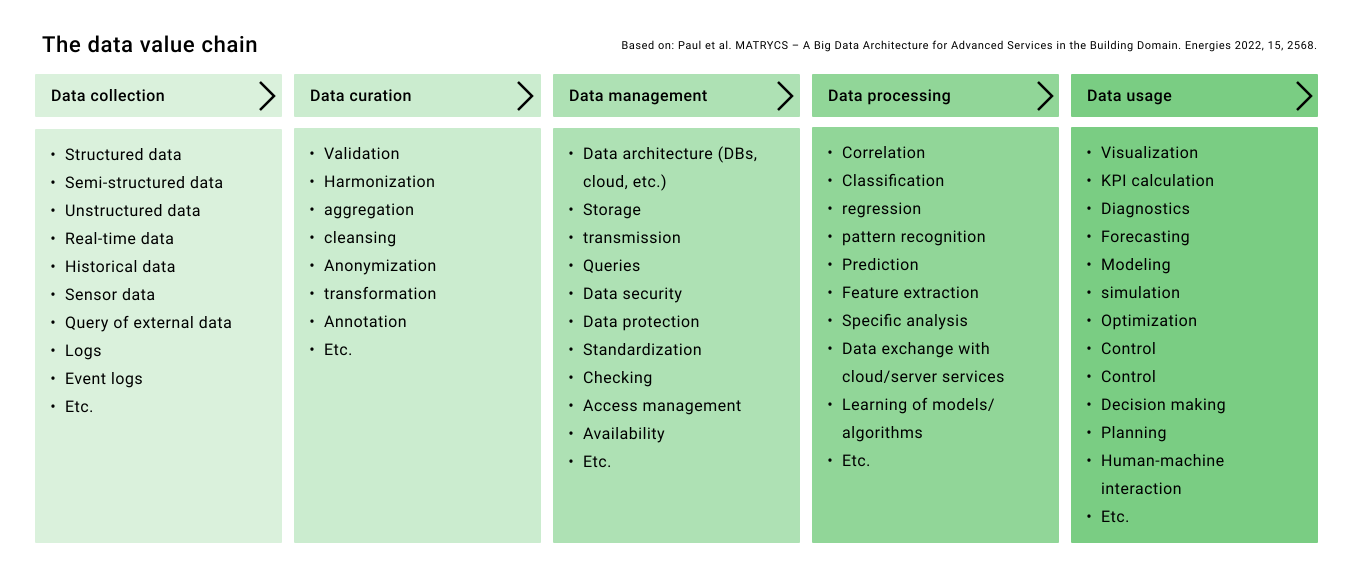
During the usage phase, the corresponding process steps are continuously executed by components of the digital application. It should be noted that the resulting energy consumption during operation, which is necessary for realizing the data value chain, must be allocated accordingly. A simplified example is a temperature sensor in the building, whose measurement value is queried every 15 minutes directly by a workstation in the same building. For this process step (querying sensor data), there is a corresponding data load and associated energy consumption – specifically by the workstation. Additionally, energy is also consumed for the operation of the sensor (e.g., battery-operated wireless sensor). This energy consumption is in turn attributable to the component itself (see
„Efforts for often used components“).
Estimation of the effort required for data processing
Users of digital applications often do not know the bandwidths (data volume/time unit) of individual process steps. For a simple estimation of the resource and energy consumption for data processing, the process steps can be aggregated as the total data load (GB/year) of the digital application. If, in addition, the location of the servers/data centers, the technology for data transfer, and the purpose of using the server/data center are known, the power consumption, cumulative energy demand, and greenhouse gas emissions can be estimated.
Energy consumption through data transmission: To transfer data over the internet infrastructure, energy must be expended at many points (e.g., repeaters, amplifiers) to operate the devices. Depending on the location of the data center (length of the transmission route), the data transfer involves a varying amount of infrastructure and, consequently, energy consumption, which generally increases with distance. The energy consumption also varies depending on the data transmission technology of the access networks (e.g., wireless/wired). In the literature, estimates of energy consumption for data transmission vary significantly, with factors such as the age of the technology and the system boundaries considered having a major influence (Coroama et al. 2015; Gröger et al. 2021; Gröger 2020; Wohlschlager et al. 2022; Wu et al. 2019; Gährs et al. 2021).
Broadly speaking, data transmission up to the data center entrance is composed of the sender's network equipment, the access network (e.g., 4G network), and the core network of the internet. The energy consumption for the access and core networks often remains hidden from users of digital applications, which is why it is estimated here.
The energy consumption of the core network is assumed to be 52 Wh/GB (Gröger 2020; Schien et al. 2015). Three technologies were considered for the access networks: two wireless networks, 4G and 5G, and one wired technology, VDSL (representative of fixed access broadband networks - FAN). The projected consumption values for 2024 from Wu et al. (2019) were used for these technologies, resulting in 40 Wh/GB (4G), 9 Wh/GB (5G), and 10 Wh/GB (FAN). To account for different server distances, a correction factor was calculated based on literature data. This correction factor, referred to as the markup factor here, reflects the additional power consumption of infrastructure components depending on the server location. For server locations in Europe and the USA, an additional power consumption of 0.3 W and 1 W, respectively, was found for a defined data stream of 1 GB/h, compared to the server location in Germany (Gröger et al. 2021). For the factor calculation, this additional power consumption was compared to the power consumption values of data transmission via VDSL, 4G, and 5G determined by Gröger et al. (2021). The resulting markup factors are detailed in Table 1. The power consumption at each location can then be estimated by multiplying the sum of the core and access network consumption by the respective markup factor. The resulting values are listed in Table 2. The resulting greenhouse gas emissions are also provided there, estimated from the emission factors of the locations. To accurately calculate the CO2 footprint along the transmission path, the exact transmission path would need to be known to incorporate country-specific emission factors into the calculations.
Table 1: Mark-up factors for longer transmission distances. Derived from the ratio of additional power consumption due to longer distances to the technology-specific power consumption of all components of the access and core networks at the Germany site. Based on the values in (Gröger et al. 2021)
| Mark-up Factors for Longer Transmission Distances |
VDSL |
4G (LTE) |
5G |
| Germany |
1,00 |
1,00 |
1,00 |
| Europe (Except GER) |
1,18 |
1,03 |
1,10 |
| USA/Asia |
1,61 |
1,11 |
1,34 |
Table 2: Overview of location-dependent electricity consumption and greenhouse gas emissions caused by the technology-dependent transmission of one GB.
|
Energy Consumption (Electricity) Data Transmission [kWh/GB]
|
Greenhouse Gas Emissions Data Transmission [kg CO2eq/GB]
|
|
VDSL |
4G (LTE) |
5G |
VDSL |
4G (LTE) |
5G |
| Germany |
0,062 |
0,092 |
0,061 |
0,031 |
0,046 |
0,030 |
| Europe (Except GER) |
0,071 |
0,093 |
0,066 |
0,018 |
0,023 |
0,017 |
| USA/Asia |
0,094 |
0,097 |
0,079 |
0,037 |
0,038 |
0,031 |
Energy and resource consumption in the data center (based on the study Green Cloud Computing (Gröger et al. 2021)): With data entry into the data center, energy consumption arises from the operation of hardware in the data center (e.g., servers, cooling, network technology). This must be proportionally allocated to the resources used by the digital application’s data. Since data centers differ in efficiency, the energy consumption for one GB of data varies depending on the data center. Additionally, it must be noted that the amount of energy consumption depends on the services to be performed in the data center. Different services use the data center’s hardware components (i.e., storage, memory, processor, infrastructure) to varying extents. Thus, the CO2 footprint of the utilized hardware in the data center varies depending on the service. For example, hardware used for simple data storage (backup) is utilized differently than for online applications running on the data center's servers that are only queried or used by the digital application at specific times.
Common services for which digital applications are used in data centers in research projects include pure data storage/backup (referred to as the use case “Online Storage”) and the processing (e.g., using analysis algorithms), utilization, and subsequent storage of data. The latter use case (referred to here as “virtual machine”) can be roughly compared to using a server as a virtual desktop environment. While data storage primarily uses the resource “storage” and can be physically allocated as a portion of the utilized storage capacity, users of virtual machines are only virtually promised physical resources. This does not necessarily result in physical occupancy, as e.g., memory may be freed up for other processes after data processing is completed. The authors of Green Cloud Computing consider the number of users as the benefit for the virtual machine use case (referred to as “Virtual Desktop Infrastructure” in the Green Cloud Computing study). However, for research projects, the focus is not on the number of users, but rather on the processing and storage of data using virtual resources. Therefore, the benefit is also defined here as occupied storage space. This simplifies the estimation of the resulting energy and resource costs. This approach means that the incoming data load is processed further in the data center and then stored with the same size [GB] as at the input.
The following describes the calculation of the key figures for estimating the energy and resource consumption based on the use cases:
-
CO2 footprint of data centers based on the work of Gröger et al. 2021: The components/resources of different data centers were categorized into servers, storage, network, and infrastructure, and their energy consumption was quantified. The data centers where the respective use case is applied differ quite significantly regarding their key figures. For the case of 'Online-Storage', the values from four test data centers examined in the study for this use case were averaged and related to the average storage capacity of all data centers. For the use case 'Virtual Machine', the key figures of two data centers of a federal agency were used, based on the use case 'Virtual Desktop Infrastructure'. In a virtual desktop infrastructure, both the operating system and the software applications run on the data center. Therefore, only a comparably resource-light computer (i.e., no complex processes are performed on the computer itself) is required to access the data center and process/display input and output. For typical applications of a federal agency, the authors of Green Cloud Computing calculate an annual CO2 footprint of 59 kg CO2eq/user. The authors also assume that the use of the virtual infrastructure by the 890 users occupies about 9% of the storage capacity, which can also be physically allocated. With a total storage capacity of 213.6 TB, this results in 19.3 TB for the use of the virtual infrastructure, or 21.6 GB/user. Assuming that all other processes (servers, infrastructure, network – allocation factors are similar for all shares in the study) change proportionally with the storage capacity and that a research project equals one user, the CO2 footprint can be expressed by the quotient of data volume and GB/user of the use case. For example, if a project has a data volume of 10 GB/a, this estimation results in a CO2 footprint of 27.3 kg CO2eq/a (10 GB/a / 21.6 GB/a * 59 kg CO2eq/a).
-
Calculation of the Cumulative Energy Demand (CED) from the CO2 Footprint: The CO2 footprint and the CED are closely linked. Since it is assumed in all cases that the processes involved are the same across the life cycle phases, the CED is initially linked through a constant. This was determined for the data centers studied in Gröger et al. (2021) and thus converted the CO2 footprints calculated under 1). Note that the conversion of GHG emissions significantly includes the emission factor of the electricity mix for the usage phase. The key figures listed here therefore include a higher, older emission factor for electricity (0.635 kg CO2eq/kWh), which makes the figures somewhat conservative. Since the use cases in the Green Cloud Computing study only refer to one location (Germany) of the servers, the cumulative energy demand at other locations (EU and USA) was approximated from the estimated electricity consumption in the data center (see Table 3).
-
Estimation of the Electricity Consumption of Data Centers During the Usage Phase: Broken down by life cycle phase, the majority of CO2 emissions stem from the operation of the data center. It should be noted, however, that the distribution of emissions between manufacturing and usage is highly dependent on the data center. Nevertheless, electricity consumption and its composition by energy carrier have a significant impact on the CO2 footprint. The importance of energy efficiency in data centers is therefore also considered in the Energy Efficiency Act (EnEfG) – although only for relatively large data centers. Electricity consumption can be estimated from the cumulative energy consumption and the location-dependent primary energy factor for electricity. For estimating the cumulative energy consumption at other locations (EU, USA), it is assumed that the absolute electricity consumption is independent of the data center's location (neglecting external influences like weather).
The key figures resulting from the calculation for the two use cases are presented in Table 3.
Table 3: Overview of location-dependent greenhouse gas emissions, cumulative energy consumption, and electricity consumption for storing or processing + storing 1 GB in a data center. Note: Actual values may vary significantly depending on the data center. The values provided here can only be used for estimation purposes. PEF = Primary Energy Factor.
|
Annual Values for Data Center Location Germany
|
Online-Storage / Backup |
Virtual Machine |
Remarks |
|
Annual Greenhouse Gas Emissions Data Center [kg CO2eq/GB]
|
0,21 |
2,73 |
|
|
Annual Cumulative Energy Consumption Data Center [kWh_primary/GB]
|
0,94 |
12,74 |
|
|
Annual Electricity Consumption [kWh_el/GB]
|
0,31 |
4,25 |
Assumed PEF = 3,0 |
|
Estimated Values for Data Centers Outside Germany
|
Online-Storage / Backup |
Virtual Machine |
Remarks |
|
Annual Greenhouse Gas Emissions Data Center EU (excluding DE) [kg CO2eq/GB]
|
0,14 |
1,82 |
|
|
Annual Greenhouse Gas Emissions Data Center USA [kg CO2eq/GB]
|
0,21 |
2,73 |
|
|
Annual Cumulative Energy Consumption Data Center EU (excluding DE) [kWh_primary/GB]
|
0,63 |
8,49 |
Assumed PEF = 2,0 |
|
Annual Cumulative Energy Consumption Data Center USA [kWh_primary/GB]
|
0,94 |
12,74 |
Assumed PEF = 3,0 |
Notes on the Use of Key Figures
The values mentioned above provide a rough orientation. Actual emissions can vary significantly depending on the data center (location, equipment, efficiency, energy mix, etc.) and – as will become evident – especially due to the use case. For general internet use, a much lower CO2 footprint of 0.032 kg CO2eq/GB can be found (Obringer et al. 2021). It should also be noted that literature values can vary significantly regarding energy consumption/emissions. Technological advances/efficiency gains along the entire data value chain, as well as different methods of calculating environmental impacts, lead to varying values. Furthermore, the specification of specific values such as kWh/GB is questioned (Kamiya 2020). For instance, computational effects like a proportionally increasing data traffic can make data transmission appear more efficient (Gröger 2020).
Further reading
-
Coroama, Vlad C., Daniel Schien, Chris Preist und Lorenz M. Hilty (2015): The Energy Intensity of the Internet: Home and Access Networks. In: ICT Innovations for Sustainability, hg. v. Lorenz M. Hilty und Bernard Aebischer, S. 137–155. Cham.
-
Gährs, Swantje, Hannes Bluhm, Elisa Dunkelberg, Jannes Katner, Julika Weiß, Peter Henning, Laurenz Hermann und Knauff Matthias (2021): Potenziale der Digitalisierung für die Minderung von Treibhausgasemissionen im Energiebereich.
-
Gröger, Jens (2020): Digitaler CO2-Fußabdruck - Datensammlung zur Abschätzung von Herstellungsaufwand, Energieverbrauch und Nutzung digitaler Endgeräte und Dienste.
-
Gröger, Jens, Ran Liu, Lutz Stobbe, Jens Druschke und Nikolai Richter (2021): Green Cloud Computing. Umweltbundesamt. https://www.umweltbundesamt.de/publikationen/green-cloud-computing.
-
Kamiya, George (2020): The carbon footprint of streaming video: fact-checking the headlines – Analysis. IEA. Website: https://www.iea.org/commentaries/the-carbon-footprint-of-streaming-video-fact-checking-the-headlines (Zugriff: 13. Juni 2024).
-
Obringer, Renee, Benjamin Rachunok, Debora Maia-Silva, Maryam Arbabzadeh, Roshanak Nateghi und Kaveh Madani (2021): The overlooked environmental footprint of increasing Internet use. Resources, Conservation and Recycling 167 (1. April): 105389.
-
Schien, Daniel, Vlad C. Coroama, Lorenz M. Hilty und Chris Preist (2015): The Energy Intensity of the Internet: Edge and Core Networks. In: ICT Innovations for Sustainability, hg. v. Lorenz M. Hilty und Bernard Aebischer, S. 157–170. Cham.
-
Wohlschlager, Daniela, Sofia Haas und Anika Neitz-Regett (2022): Comparative environmental impact assessment of ICT for smart charging of electric vehicles in Germany. Procedia CIRP 105: 583–588.
-
Wu, Anson, Paul Ryan und Terence Smith (2019): Intelligent Efficiency For Data Centres & Wide Area Networks. Report Prepared for IEA-4E EDNA. https://www.iea-4e.org/wp-content/uploads/publications/2019/05/A1b_-_DC_WAN_V1.0.pdf.